
Power to Weight Ratio Calculator
Instantly calculate performance ratios using power and weight.
Watts per Kg
0kW per Tonne
0Megawatt per Kg
0Horsepower per Kg
0Horsepower per Pound
0Horsepower per Ton
0Understanding Power to Weight Ratio Calculator
A Power to Weight Ratio Calculator helps measure how much power a vehicle or machine produces relative to its weight. This ratio is an important indicator of real-world performance, showing how quickly a car, motorcycle, electric vehicle (EV), racing bike, or even a cyclist can accelerate. Users can enter power in watts (W), kilowatts (kW), or horsepower (HP) and weight in kilograms (kg), tonnes (t), or pounds (lb) to get a clear performance value. Vehicles with higher ratios typically accelerate faster, while heavier vehicles with the same power may feel slower. This tool is useful for automotive enthusiasts, students, engineers, and athletes who want practical insights without complex calculations.
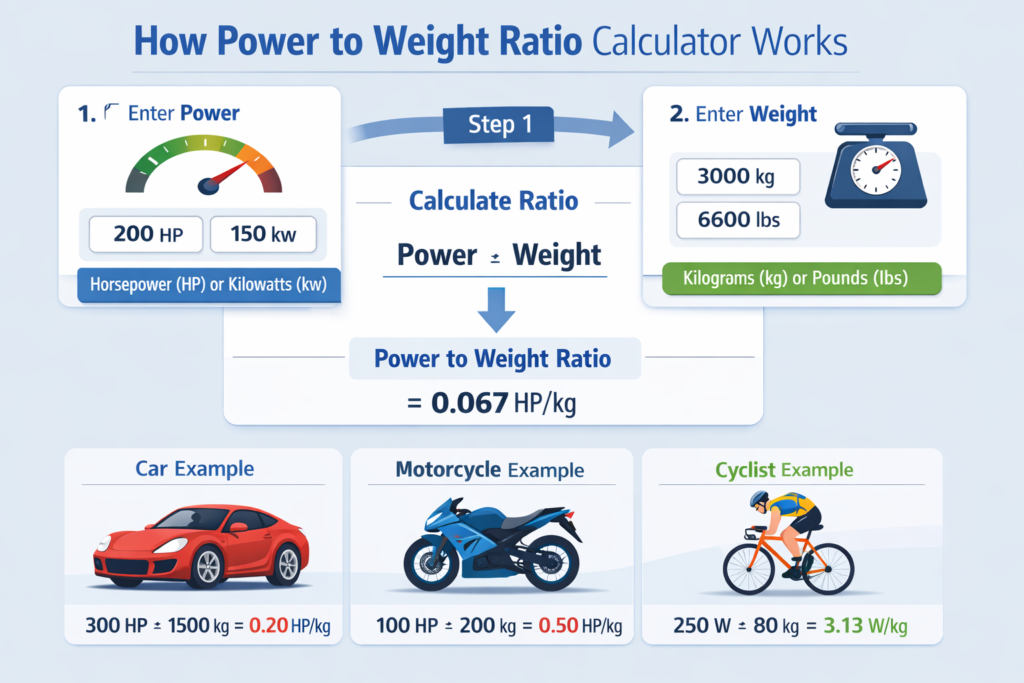
What is a Power to Weight Ratio Calculator?
A Power to Weight Ratio Calculator is an online tool that divides engine or motor power by the total weight of a vehicle to show performance per unit of weight. This allows users to compare vehicles accurately. The calculator automatically converts units, providing results in watts per kilogram (W/kg), kilowatts per tonne (kW/t), or horsepower per kilogram (HP/kg).
Formula: Power to Weight Ratio = Power ÷ Weight (for example, 300 kW ÷ 1500 kg = 0.2 kW/kg)
Understanding this ratio is important because a heavy vehicle with high power may perform similarly to a lighter vehicle with moderate power. The calculator simplifies comparisons, helping users evaluate acceleration potential and efficiency without doing manual math.
Exploring Performance Metrics: Power to Mass Ratio Explained
The Power to Mass Ratio is a key metric that helps measure the efficiency and performance of a vehicle, machine, or even an athlete. It compares the engine or motor’s power to the total mass, showing how effectively power translates into acceleration and speed. Higher ratios indicate quicker acceleration, better agility, and enhanced overall performance, while lower ratios may indicate slower responsiveness. While this ratio is often used in technical and engineering contexts, it provides the same practical insights as the power to weight ratio in everyday vehicle comparisons. Understanding this metric allows enthusiasts, engineers, and athletes to make informed decisions about performance, efficiency, and training.
How to Use the Power to Weight Ratio Calculator
Enter Power and Weight
Input the total power of your vehicle or machine in HP, kW, or W, and the weight in kg, t, or lb. This works for cars, motorcycles (including LAMS), EVs, and cyclists measuring W/kg for performance.
Select Units
Choose your preferred units before viewing results. The calculator automatically converts HP to kW and lbs to kg instantly and efficiently, so values remain accurate and comparable across different vehicles or measurement setups.
View Results
Results are displayed in formats such as HP per tonne, kW/t, or W/kg. These formats make it easy for users to quickly understand and compare acceleration, climbing ability, and overall athletic or vehicle performance.
Set Target Ratios
Click any result to set a target ratio, such as 150 kW/t for LAMS compliance or cycling goals. The tool will then show the required power to reach that target, helping users easily plan upgrades, training, and performance improvements.
Why Power to Weight Ratio Matters
Acceleration depends on how much power is available to move a vehicle’s weight. When power is high and weight is low, the vehicle gains speed faster and feels more responsive. This ratio often provides a clearer picture of performance than horsepower alone.
For example, a lightweight sports car with moderate power can outperform a heavier car with higher horsepower, especially during quick acceleration, cornering, or driving on tight roads. A Power to Weight Ratio Calculator makes this relationship easy to measure and understand.
The Physics of Speed
Acceleration follows Newton’s Second Law: F = ma (Force = Mass × Acceleration). Rearranging gives a = F ÷ m. To accelerate faster, you can either increase power or reduce weight. This explains why a Lotus Elise with 200 HP can be quicker than a 400 HP muscle car on twisty tracks. The calculator quantifies this instantly, helping compare vehicles or cyclists in a practical way.
Benchmark Chart – Vehicle Performance Guide
| Vehicle Category | Power Ratio (kW/t) | Watts/kg | Est. 0–60 mph |
| Economy Car | 60–75 | 60–75 | 10.0s+ |
| LAMS / P-Plate | 130 | 130 | 7.0s–8.0s |
| Sporty Hatch | 135–165 | ~150 | 6.0s–7.0s |
| Sports Car | 185–260 | ~220 | 4.0s–5.5s |
| Supercar | 370–485 | ~400 | 2.8s–3.5s |
| Formula 1 / Hypercar | 735+ | 750+ | <2.5s |
Power to Weight Ratio in Cycling
Cyclists track W/kg to measure climbing and sprinting ability. Higher ratios indicate faster acceleration and better endurance on inclines. Amateur cyclists typically achieve 2–3 W/kg, while professionals reach 6–7 W/kg. This metric helps riders plan training and compare performance against peers.
Examples & Comparisons
| Vehicle Type | Power | Weight | Ratio |
| Car A | 500 kW | 1000 kg | 0.5 kW/kg |
| Motorcycle B | 150 kW | 200 kg | 0.75 kW/kg |
| EV C | 250 kW | 1500 kg | 0.167 kW/kg |
| Sports Car D | 720 HP | 1200 kg | 0.6 HP/kg |
Motorcycles often have higher ratios due to lower weight, while electric vehicles vary depending on battery size. This calculator allows enthusiasts to compare acceleration and overall performance accurately.
Units & Conversion
Conversions are simple: HP ÷ Weight in kg = HP/kg. The calculator handles all unit conversions automatically, saving time and reducing errors.
Why Use This Power to Weight Ratio Calculator
This tool supports multiple units and vehicle types, giving instant, accurate, and comparable results. It helps users understand the impact of power and weight on acceleration and performance without complex formulas. Whether for cars, motorcycles, EVs, or cycling, it provides actionable insights rather than just numbers.