
HP to Weight Ratio Calculator
HP to Weight Ratio Calculator
The Hp to Weight Ratio Calculator helps users understand how vehicle power actually works when engine horsepower is compared with total weight. Many people check only horsepower while comparing cars, but performance depends on how efficiently that power moves the vehicle mass. A heavier vehicle may have a strong engine but still feel slower, while a lighter vehicle with moderate power can feel quicker during acceleration.
This Power to Weight Ratio Calculator provides a simple way to measure that balance. Just enter horsepower and weight, and instantly see how much power your vehicle has relative to its size. The result gives a clear performance idea without any technical knowledge or manual calculations.
Understanding Vehicle Performance Beyond Horsepower
Horsepower numbers often look impressive, but they do not always represent real driving experience. Every vehicle carries structural weight, engine components, fuel, and passengers. The engine must move all of this mass, and that effort directly affects acceleration.
Because of this, automotive comparisons frequently use hp to weight ratio instead of relying only on engine output. When power and weight are analyzed together, performance differences become easier to understand.
For example, two cars may produce the same horsepower, yet the lighter one usually responds faster when accelerating. This difference becomes noticeable in city driving, highway merging, and overtaking situations.
How the HP to Weight Ratio Calculator Works
The calculator measures how efficiently engine power moves a vehicle by applying a simple mathematical relationship between horsepower and weight. Users only need to enter basic values, and the system calculates the result instantly. The tool removes confusion caused by manual formulas and unit conversions. Instead of calculating separately, users receive clear output in seconds.
Supported Measurement Options
Vehicle weight is measured differently across regions. To make calculations practical for everyone, the calculator supports multiple unit systems:
- KG with horsepower input for metric users
- Pounds with horsepower input for imperial measurements
- HP per ton format for easier vehicle comparison
These options allow users searching with different measurement preferences to calculate results without additional steps.
Simple Formula Behind the Calculation
The calculation follows a straightforward method:
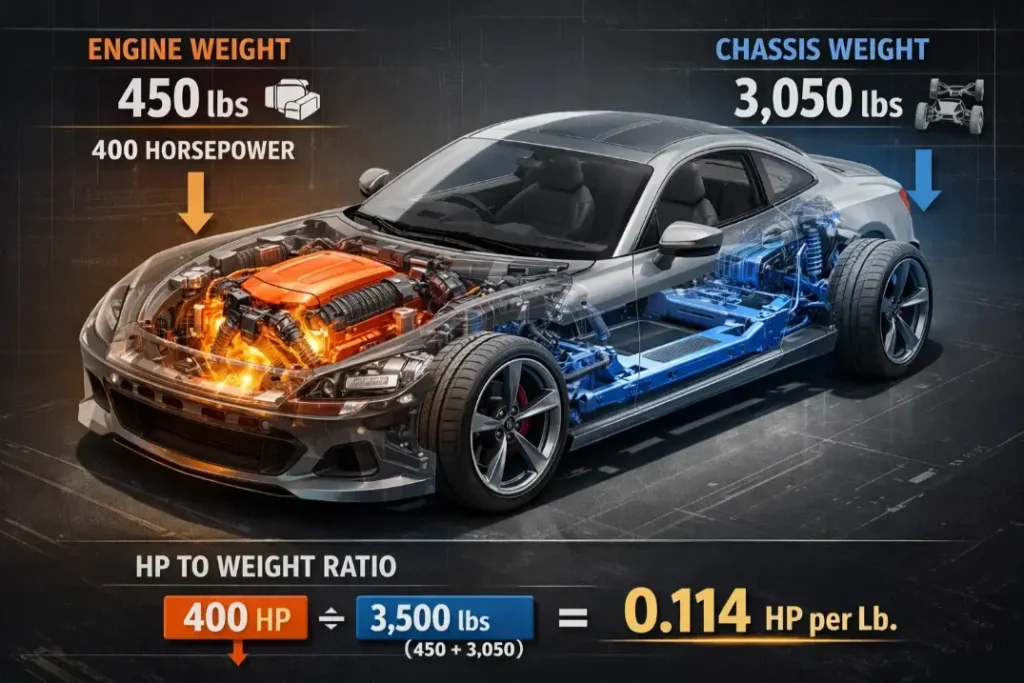
Horsepower ÷ Vehicle Weight
Although simple, this formula explains how much work the engine performs to move the vehicle. A higher result usually indicates stronger acceleration potential because less weight is being moved by each unit of power.
Example Calculations
Practical examples help users understand how results change depending on weight differences.
Example: HP to Weight Ratio = Horsepower ÷ Vehicle Weight (for example, 220 HP ÷ 1,900 KG = 0.116 HP/kg)
Understanding Your Result Range
After calculation, users can interpret results using general performance categories:
- Below 100 HP per ton — basic performance level
- 100 to 180 HP per ton — balanced daily driving range
- 180 to 300 HP per ton — sporty response and quicker acceleration
- Above 300 HP per ton — performance-focused vehicles
These ranges provide guidance rather than fixed rules because other factors also influence driving behavior.
Why Vehicle Weight Impacts Performance
Vehicle weight directly affects how quickly power turns into motion. When weight increases, the engine needs more effort to move the vehicle forward. Reducing weight allows available horsepower to work more efficiently.
Key effects of lower weight include:
- Faster acceleration response
- Improved braking control
- Better handling balance
- Reduced strain on mechanical components
Because of these advantages, manufacturers often focus on maintaining balanced vehicle weight rather than only increasing engine size.
Compare Vehicles Based on HP to Weight Ratio
A weight to hp ratio calculator allows users to compare vehicles realistically. Engine size alone does not provide a fair comparison, especially when vehicles belong to different categories.
For instance:
- A compact turbocharged car may feel faster than a larger sedan.
- A lightweight coupe may respond quicker than a powerful SUV.
- Vehicles with similar horsepower can deliver completely different driving experiences.
Using ratio comparison helps users understand performance expectations before making decisions.
Real-Life HP to Weight Insights
Automotive enthusiasts frequently compare hp to weight ratio cars because it explains performance differences clearly. Sports cars often achieve higher ratios by combining strong engines with lighter construction.
People searching for best hp to weight ratio cars usually notice that performance models focus heavily on reducing unnecessary mass. Balanced engineering often produces better acceleration without extremely large engines.
Similarly, discussions about cars with best hp to weight ratio highlight how design efficiency matters as much as raw engine output.
Common Mistakes During Calculation
Users sometimes receive unexpected results due to incorrect inputs. To ensure accuracy:
- Use total vehicle weight including fluids
- Select the correct unit before entering value
- Avoid mixing kilograms and pounds
- Consider added accessories or modifications
Accurate input values produce meaningful performance insight.
Who Can Use This Calculator
This tool is useful for a wide range of users:
- Buyers comparing vehicle options
- Automotive bloggers creating comparisons
- Students learning performance basics
- Enthusiasts analyzing specifications
- Everyday drivers curious about vehicle capability
No technical background is required, which makes the calculator easy for beginners.
Practical Importance of Performance Balance
Vehicle performance is not only about speed. Balanced power and weight influence everyday driving comfort as well. Cars with proper balance often feel smoother during acceleration and more stable at higher speeds.
Understanding this relationship helps users evaluate vehicles realistically instead of relying only on advertised engine numbers.
Reliable Performance Insight in One Place
The Hp to Weight Ratio Calculator provides a practical way to understand how engine power interacts with vehicle mass. Supporting kilograms, pounds, and HP per ton ensures that users from different regions can calculate results easily.
Whether someone is comparing vehicles, learning automotive basics, or analyzing specifications, this calculator offers clear performance understanding in a simple format. By focusing on the relationship between power and weight, users gain a more realistic view of vehicle capability and driving behavior.
Why HP per Ton Is Popular
HP per ton simplifies performance understanding because it presents results in a clear format. Instead of small decimal numbers, users see how much horsepower moves one ton of weight.
Benefits include:
- Easier vehicle comparison
- Clear performance reference
- Commonly used automotive measurement
- Simple interpretation for beginners
Because of this clarity, many reviews and comparisons prefer HP
Final Words
The HP to Weight Ratio Calculator provides a clear and practical way to understand vehicle performance beyond just horsepower numbers. By considering both engine power and total weight, users gain a realistic view of acceleration, handling, and overall driving behavior. Whether you’re comparing vehicles, learning automotive basics, or analyzing specifications, this tool simplifies complex calculations and helps make informed decisions about car performance.